Ask Questions

Showing posts with label Ancient Indian History. Show all posts

Saturday, 31 October 2020

Kushan Empire - Origin, Achievements & Kanishka's Rule

 Kushans or Kuei-Shang were one of the five Great Yueh-chi (tribes) principalities. In the 1st century CE, Kujula Kadphises (Kadphises I) brought together these five principalities and founded the Kushan Empire. The Kushans movement in India can be traced back to the first century CE during Kadphises I time.

You can also read to similar articles provided in the table below:

Kushan Empire Origin

  • Kushanas are considered to be one of the five branches of the Yuezhi tribe who lived in the Chinese frontier or central Asia.
  • They are known as Guishuang in Chinese sources.
  • They eventually acquired dominance over the other Yuezhi tribes.
  • They moved eastward towards India defeating the Parthians and the Sakas in the 1st century AD.

Kushan Empire – Ruler Kujula Kadphises or Kadphises I [AD 30-AD 80)

  • Kujula Kadphises was the first Yuezhi chief to lay the foundation of the Kushana Empire in India.
  • He established his supremacy over Kabul, Kandahar and Afghanistan.
  • He was succeeded by his son Vima Taktu or Sadashkana (AD 80 -AD 95) who expanded the empire into northwest India.

Kushan Empire – Ruler Vima Kadphises [AD 95-AD 127]

  • An inscription found at Rabatak in Afghanistan mentions that he was the son of Vima Taktu and the father of Kanishka.
  • He has issued a large number of gold coins.
  • He was a Shiva devotee as is clear from coins issued by him.
  • A large number of Roman gold coins found from this era indicate the prosperity of India at that time and also the growing trade with the Romans.

Kanishka of Kushan Dynasty [127 AD – 150 AD]

  • Considered the greatest Kushana king and also a great king of ancient India.
  • Son of Vima Kadphises.
  • His kingdom included Afghanistan, parts of Sindhu, parts of Parthia, Punjab, Kashmir, parts of Magadha (including Pataliputra), Malwa, Benaras, perhaps parts of Bengal, Khotan, Kashgar, Yarkhand (last three in modern China). His empire covered Gandhara, Peshawar, Oudh, Pataliputra, Kashmir and Mathura. His kingdom also included parts of Uzbekistan and Tajikistan.
  • His main capital was Peshawar, then known as Purushpura.
  • After the capture of Pataliputra, he is said to have taken away the Buddhist monk Ashvaghosha with him to Peshawar.
  • The scholars in his court included Parsva, Ashvaghosha, Vasumitra, Nagarjuna, Charaka and Mathara. He also patronised the Greek engineer Agesilaus.
  • Kanishka convened the fourth Buddhist Council at Kundalvana in Kashmir.
  • He patronised Buddhism although he was very tolerant in his religious views. His coins contain a mix of Indian, Greek and Zoroastrian deities.
  • He was also a patron of art and architecture. The Gandhara School of art flourished under him.
  • He also propagated the Mahayana form of Buddhism and he was largely responsible for propagating it in China.
  • It is not known how he died.

Achievements of Kushanas – Significance of the Kushana Empire

  • Sanskrit literature began to be developed during this time. The fourth Buddhist council was held in Sanskrit.
  • Ashvoghosha is considered to be the first Sanskrit dramatist.
  • During this time, three distinct schools of art flourished: Gandhara School in northwest India, Amaravati School in Andhra and the Mathura School in the Ganges valley.
  • Trade prospered between India and China, and India and the Roman Empire.
  • The Kushanas controlled large parts of the Silk Route which led to the propagation of Buddhism into China. It was during this time that Buddhism began to spread to Korea and Japan also.
  • Many towers, Chaityas, towns and beautiful sculptures were built under the patronage of the Kushana kings.
  • Kushanas were foreign invaders, to begin with, but they were completely Indianised in ways and culture.
  • It is said that the Kushana period in Indian history was a perfect forerunner to the golden age of the Guptas.

The decline of the Kushana Empire

  • Kanishka was succeeded by his son Vasishka.
  • Vasishka was followed by Huvishka and Kanishka II (son of Vasishka).
  • Kanishka II was followed by Vasudeva I.
  • Vasudeva I was the last great king of the Kushanas. After his death, the empire disintegrated away. He probably died in 232 AD.
Indo-Greek Rule

The Bactrian Greeks moved into the south of the Hindu Kush area by the early 2nd century BCE. Indo-Greeks are these groups of these Bactrian Greeks that ruled over north-western India between the 2nd century BCE and early 1st century CE.

Aspirants can read the important articles similar to Indo-Greek rule from the links provided below:

Indo-Greek Rule

After the decline of the Mauryas, northern India was split into several kingdoms. In the Magadha region, the Sungas came to power in about 185 BC. After that, the Kanvas came to power who were defeated by the Satavahanas originally from the Deccan. Northwest India was constantly under attack from powers in Central Asia and northwest. The Indo-Greek or the Graeco-Indian Kingdom has established around 180 BC when the Graeco-Bactrian king Demetrius invaded the Indian subcontinent.

Indo-Greeks – Initial presence of Greeks in India

  • After Alexander invaded the northwest part of the subcontinent, one of his generals, Seleucus Nicator, founded the Seleucid Empire.
  • In Seleucus’s conflict with the mighty Chandragupta Maurya, he ceded large parts to the west of the Indus, including the Hindu Kush, present-day Afghanistan and Balochistan to the Mauryan king.
  • After this, Megasthenes was sent to reside at Chandragupta Maurya’s court. Other Greek residents at Mauryan courts were Deimachus and Dionysius.
  • Greek populations lived in the north-western part of the Mauryan Empire as evident from Ashoka’s edicts.
  • Mauryas also had departments to take care of foreigners like Yavanas (Greeks) and Persians.
  • In ancient Indian sources, Greeks were called Yavanas (Sanskrit) and Yonas (Pali).

Indo-Greek Kingdom

  • The Indo-Greek kingdom was ruled by over 30 Hellenistic (Greek) kings in the northwest and north India from the 2nd century BC to the beginning of the first century AD.
  • The kingdom started when Graeco-Bactrian king Demetrius (son of Euthydemus I) invaded India around 180 BC. He conquered southern Afghanistan and parts of Punjab.
  • The Indo-Greek kings imbibed Indian culture and became political entities with a mix of Greek and Indian culture.
  • For about 25 years, the Indo-Greek kingdoms were under the Euthydemid rule.
  • Many coins have been unearthed of these kings and most of the information we get about them is from these coins. Coins have been found with Indian and Greek inscriptions. Many coins have been found with images of Indian deities also. The Indo-Greek kings did this to perhaps placate the population most of whom were not Greeks.
  • The civil wars among the many Bactrian kings after the death of Demetrius facilitated the independent kingdom of Apollodotus I who, in this way, can be regarded as the first proper Indo-Greek king (whose rule was not from Bactria).
  • His kingdom included Gandhara and western Punjab.
  • Most of the Indo-Greek kings were Buddhists and Buddhism flourished under their rule.
  • Greek influence is mostly seen in art and sculpture, particularly the Gandhara School of art.

Indo-Greek Rulers – Menander I (Reign: 155 or 150 BC – 130 BC)

  • Menander I Soter was also known as Minedra, Minadra, or Milinda (in Pali).
  • He was initially a king of Bactria. His empire extended from Kabul river valley in the west to the Ravi River in the east, and from Swat valley in the north to Arachosia (Helmand in Afghanistan).
  • According to some Indian sources, he went as far as Rajasthan and Pataliputra.
  • He converted to Buddhism and patronised the faith.
  • He died in 130 BC and was succeeded by his son Strato I.
  • The Milinda Panha (composed around 100 BC) records a dialogue between Milinda and the Buddhist sage Nagasena. Originally written in Sanskrit, only the Pali version is available now. In the work, Milinda is described as a wise, learned, and able king. At the end of it, Milinda accepts Buddhism and converts.

Coins of Indo-Greeks

The following points are important to remember for UPSC Prelims:

Coins circulated to the north of Hindu Kush region during the rule of Indo-Greeks

  1. There were gold, silver, copper and nickel coins
  2. The coins had greek legends
  3. The Indo-Greek coins had royal portraits on the obverse and greek deities (Zeus, Apollo, and Athena) on the reverse.

Coins circulated to the south of Hindu Kush region during the rule of Indo-Greeks

  1. There were silver and copper coins (mostly in square shape)
  2. Indian weight standards were followed in making of these coins.
  3. They had bilingual inscriptions – Greek and Kharoshthi
  4. On the obverse of the coin, royal portraits were present and on the reverse, religious symbols (mostly Indian in inspiration) were present

Decline of the Indo-Greek Kingdom

  • The last Indo-Greek king was Strato II. He ruled the Punjab region until 55 BC, some say until 10 AD.
  • Their rule ended with the invasions of the Indo-Scythians (Sakas).
  • It is believed that Greek people lived for several centuries more in India under the Indo-Parthians and the Kushans.

Sunga Dynasty

 After the death of Ashoka, the Mauryan Empire steadily disintegrated as his successors were not able to keep the vast empire from fracturing away. Independent kingdoms arose out of the provinces. Foreign invasions were occurring in the northwest. Kalinga declared its independence. In the South, the Satavahanas rose to power and in the Gangetic plains, Sunga or Shunga dynasty replaced the Mauryas.


Pushyamitra Sunga
  • Pushyamitra Sunga was Brahmin army chief of Brihadratha, the last king of the Mauryas.
  • During a military parade, he killed Brihadratha and established himself on the throne in 185 or 186 BC.
  • According to some historians, this was an internal revolt against the last Mauryan king. Some say it was a Brahminical reaction to the Mauryan overwhelming patronage of Buddhism.
  • Pushyamitra Sunga’s capital was at Pataliputra.
  • He successfully countered attacks from two Greek kings namely, Menander and Demetrius.
  • He also thwarted an attack from the Kalinga king Kharavela.
  • He conquered Vidarbha.
  • He followed Brahminism. Some accounts portray him as a persecutor of Buddhists and a destroyer of stupas but there has been no authoritative evidence to this claim.
  • During his reign, the Stupas at Sanchi and Barhut were renovated. He built the sculptured stone gateway at Sanchi.
  • He performed Vedic sacrifices such as Ashvamedha, Rajasuya and Vajapeya.
  • Pushyamitra Sunga patronised the Sanskrit grammarian Patanjali.
  • According to the Puranas, his reign lasted for 36 years. He died in 151 BC.

Agnimitra
  • Was Pushyamitra’s son who succeeded him to the throne.
  • His reign lasted from about 149 BC to 141 BC.
  • By this time, Vidarbha broke away from the empire.
  • Agnimitra is the hero of Kalidasa’s poem, Malavikagnimitram.
  • His son Vasumitra succeeded him as king.

Last of the Sunga kings
  • Vasumitra’s successors are not clearly known. Different names crop up in several accounts such as Andhraka, Pulindaka, Vajramitra and Ghosha.
  • The last Sunga king was Devabhuti. He was preceded by Bhagabhadra.
  • Devabhuti was killed by his own minister, Vasudeva Kanva in around 73 BC. This established the Kanva dynasty at Magadha from 73 to 28 BC.

Effects of Sunga rule
  • Hinduism was revived under the Sungas.
  • The caste system was also revived with the rise of the Brahmanas.
  • Another important development during the Sunga reign was the emergence of various mixed castes and the integration of foreigners into Indian society.
  • The language of Sanskrit gained more prominence during this time. Even some Buddhist works of this time were composed in Sanskrit.
  • The Sungas patronised art and architecture. There was an increase in the usage of human figures and symbols in art during this period.

Era of the Kanva Dynasty

Kanva dynasty had a Brahmanic origin. The dynasty was named after the gotra of the ruler Kanva. The Kanva dynasty was founded by Vasudeva Kanva. It is believed that Vasudeva Kanva killed the Shunga ruler Devabhuti and established his own empire in 72 BCE.

Kanva dynasty had a ruling phase from 72 BCE to 28 BCE.

The chronology of Shunga, Kanva dynasty and Satvahana dynasty is given below:

  • Shunga dynasty
  • Kanva dynasty
  • Satvahana dynasty

This article throws light on the emergence of Kanva dynasty from the Shunga dynasty and other important aspects of the events that took place during the rule of the Kanva dynasty.

Shunga dynasty

The Shunga dynasty formed a large part of Magadha and was founded by Pushyamitra Shunga after the fall of the Mauryan empire. There were 10 rulers who ruled India during the ancient period. Major cultural reforms took place during the reign which is evident from the coins and inscriptions retrieved by archaeologists.

An interesting thing to note about the Sunga dynasty was the emergence of various mixed castes and the integration of foreigners into Indian society.

The language of Sanskrit gained more prominence during the rule of the Shunga kings. Even some Buddhist works of this time were composed in Sanskrit.

The major rulers of the Shunga dynasty were – Pushyamitra Sunga, Agnimitra, Bhagabhadra, Devabhuti, etc.

To know more about the Shunga dynasty, check the linked article.

Kanva dynasty

This dynasty was founded by Vasudeva Kanva. He ruled for a short period and was succeeded by Bhumimitra. The empire was extended into parts of eastern India and central India. The Kanva dynasty had claimed Vidisa as their capital.

The major rulers during that phase were:

  1. Vasudeva Kanva
  2. Bhumimitra
  3. Narayana
  4. Susarman

Bhumimitra ruled for a period of 14 years and his son Narayana ruled for 12 years. The Satvahana dynasty defeated the Kanva dynasty and established their empire. The last Kanva king Susarman was killed by the Satavahana (Andhra) king.

Satvahana dynasty

The Satavahana rule is believed to have started around the third century BC, in 235 BC and lasted until the second century AD. Simuka was the founder of the Satvahana dynasty. Their capital cities varied at different times. Pratishthana (Paithan) and Amaravati were its capitals.

Some experts believe their rule started in the first century BC only. They are referred to as Andhras in the Puranas.

The Satavahana kingdom chiefly comprised of modern-day Andhra Pradesh, Telangana and Maharashtra. At times, their rule also included parts of Karnataka, Gujarat and Madhya Pradesh.

The major rulers of the Satvahana dynasty were – Satakarni, Hala, Gautamiputra Satakarni. The administration of the Satvahana era was purely based on the Shastras and their religious views were liberal.

Friday, 30 October 2020

Gupta Empire - Facts about Gupta Dynasty

In Ancient India, the Gupta Dynasty ruled the mid-to-late 3rd century (approximately) to 543 AD. Founded by Sri Gupta, the dynasty rose to fame with rulers like Chandragupta-I, Samudragupta, etc.

You can also refer to articles related to the Gupta Empire from the links mentioned in the table below:

Origin of Gupta Empire

  • The Gupta Empire rose to prominence in 320 AD and spread to large parts of northern India, central and small parts of southern India.
  • The founder of the Gupta dynasty is Sri Gupta.
  • The original homeland of the Guptas is not known for certain. But they might have originated from Bengal. Some scholars think they are from Prayaga (Allahabad in UP).
  • They are thought to be either Brahmins or Vaishyas.

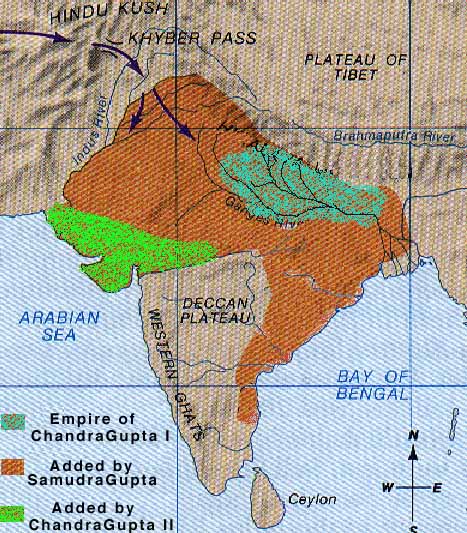
Gupta Empire - NCERT Notes on Gupta Empire| Gupta Empire's Territorial Extent

Gupta Empire – Kings

A brief about the kings of the Gupta dynasty is given in the table below:

Gupta Dynasty KingsFacts about Gupta Kings
Sri Gupta
  • Founder of Gupta Dynasty
  • Reign from 240 AD to 280 AD
  • Used the title of ‘Maharaja‘
Ghatotkacha
  • Son of Sri Gupta
  • Took the title of ‘Maharaja‘
Chandragupta I
  • Reigned from 319 AD to 334 AD
  • Started the Gupta Era
  • He assumed the title of ‘Maharajadhiraja‘
  • Married Lichchavi princess Kumaradevi
Samudragupta
  • Reigned from 335 AD to 380 AD
  • Called ‘Napolean of India’ by V.A. Smith (Irish Indologist and Art Historian)
  • His campaigns are mentioned in Eran inscription (Madhya Pradesh)
Chandragupta II
  • Reigned from 380-412 AD
  • Navratnas (9 Gems in his Court)
  • Took the title ‘Vikramaditya’
Kumaragupta I
  • Reigned from 413 AD to 455 AD
  • Founded Nalanda University
  • He was also called Shakraditya
Skandagupta
  • Reigned from 455 AD – 467 AD
  • Was a ‘Vaishnavite‘
  • Son of Kumaragupta
  • Repulsed an attack by the Hunas but this strained his empire’s coffers
Vishnugupta
  • Last known ruler of the Gupta Dynasty (540 AD – 550 AD)

Gupta Empire – Chandragupta I (320 – 335 AD)

  • Was the son of Ghatotkacha.
  • Acquired the strategically important Magadha kingdom on marriage to a Lichchhavi princess Kumaradevi.
  • He extended his kingdom through conquests. His territory extended from the Ganges River to Prayaga by 321 AD.
  • He issued coins in the joint names of his queen and himself.
  • He assumed the title of Maharajadhiraja (great king of kings).
  • He was successful in building a small principality into a great kingdom.
  • He is considered the first great king of the Gupta Empire.

Gupta Empire – Samudragupta (335 – 380 AD)

  • Son of Chandragupta I and Kumaradevi.
  • Was a military genius and was successful in adding many territories into the Gupta Empire.
  • The Allahabad inscription describes his bravery as composed by his court poet, Harisena. There it is said that he defeated nine kings of the Ganges Valley, twelve kings from the southern region, and eighteen forest tribes.
  • His region extended from the Himalayas in the north to the Krishna and Godavari Rivers in the south; and from Balkh (Afghanistan) in the west to Brahmaputra River in the east.
  • He was a follower of Vaishnavite Hinduism but was tolerant of other faiths. He gave permission to the king of Sri Lanka, Meghavarna to build a monastery in Bodh Gaya.
  • He was also called “Indian Napoleon” by art historian Vincent Smith.
  • He also performed Ashvamedha sacrifice. Hence, one of his coins refers to him as “the restorer of Ashvamedha.”
  • He was also called “Kaviraja” since he composed verses.

Gupta Empire – Chandragupta II (Reign: 380 – 418 AD)

  • Son of Samudragupta and his queen Dattadevi.
  • He was also known as ‘Vikramaditya’.
  • He further annexed territories including Saurashtra which gave him the western coastline.
  • He used matrimonial alliances to expand his kingdom. He established matrimonial alliances with the Nagas and the Vakatakas. He gave his daughter Prabhapavatigupta in marriage to Vakataka ruler of Maharashtra Rudrasena II.
  • He also annexed three Satrapa kingdoms and assumed the title Sakari (destroyer of the Sakas). He defeated the Saka king Rudrasimha III thus acquiring Saurashtra and Kathiawar.
  • Through the western ports, the kingdom’s prosperity grew through trade links with Roman Empires.
  • After East and West India, Chandragupta II defeated northern rulers also like the Hunas, Kambojas, Kiratas, etc.
  • He was a brilliant conqueror and an able administrator as well.
  • Like his father, he was a Vaishnavite but was tolerant of other religions.
  • His other names (as mentioned in coins) include Vikrama, Devagupta, Devaraja, Simhavikrama, Vikramaditya Sakari, etc.
  • His court had nine jewels or Navaratnas, nine people eminent in various fields of art, literature and science. This included the great Sanskrit poet Kalidasa, Harisena, Amarasimha (lexicographer) and Dhanvantari (physician).
  • Fa-Hien, a Buddhist from China visited India during his reign. He records the prosperity of the Gupta Empire.

Ashoka Inscription (The Edicts Of Ashoka)

The great Emperor Ashoka, the third monarch of the Maurya dynasty converted to Buddhism after witnessing the horrific effects of war in Kalinga. He became a champion and patron of Buddhism and strove to spread Dhamma throughout his empire and beyond. He erected pillars and edicts all over the subcontinent and even in modern-day Afghanistan, Nepal, Bangladesh and Pakistan to spread the Buddha’s word.

Ashoka Inscription (Rock Edicts)

James Prinsep, a British antiquary and colonial administrator was the first person to decipher Ashoka’s edicts. These Ashoka’s inscriptions are the first tangible evidence of Buddhism.

They were kept in public places and along trade routes so that maximum number of people would read them. More than religious discourses, they talk about the moral duties of the people, how to conduct life, Ashoka’s desire to be a good and benevolent ruler, and about Ashoka’s work towards this end.

Ashoka inscriptions can be classified into three: 

  • Pillar edicts,
  • Major rock edicts and
  • Minor rock edicts.

Pillar Edicts

  • There are seven pillar edicts.
  • Two types of stones are used: spotted white sandstone (from Mathura) and buff coloured sandstone and quartzite (from Amaravati).
  • All the pillars are monoliths (carved out of from stone).
  • They have been found from different places like Kandahar (Afghanistan), Khyber Pakhtunkhwa (Pakistan), Delhi, Vaishali and Champaran (Bihar), Sarnath and Allahabad (Uttar Pradesh), Amaravati (Andhra Pradesh), and Sanchi (Madhya Pradesh).
  • Fragments of the same edict are found in different places.
  • Many pillars are as high as 50 feet high and weigh as much as 50 tons.
  • The pillars depict animals such as elephants and lions and wheels and lotuses which are all significant symbols in Buddhism.

The following table gives the Edict number and what it talks about:

EdictAshoka Inscription Details
Pillar Edict IAshoka’s principle of protecting his people.
Pillar Edict IIDhamma
Pillar Edict IIIAvoiding practices of cruelty, sin, harshness, pride and anger among his subjects.
Pillar Edict IVResponsibilities of the Rajukas.
Pillar Edict VList of animals and birds that should not be killed on certain days. Another list which mentions animals that should never be killed.
Pillar Edict VIDhamma policy of the State.
Pillar Edict VIIAshoka’s work for fulfilling Dhamma. Tolerance for all sects.

Ashoka’s Major Rock Edicts

Major Rock Edicts: There are 14 major rock edicts:

EdictAshoka Inscription Details
Major Rock Edict IProhibits animal slaughter and bans festive gathering.
Major Rock Edict IICare for man and animals. Mentions the Pandyas, Satyapuras and Keralaputras of South India.
Major Rock Edict IIIGenerosity to Brahmins. About Yuktas, Pradeshikas and Rajukas who would go every five years to different parts of his empire to spread Dhamma.
Major Rock Edict IVDhammaghosha (sound of Dhamma/righteousness) over Bherighosha (sound of war).
Major Rock Edict VAbout Dhammamahamatras. Talks about treating slaves right.
Major Rock Edict VIKing’s desire to know about his people’s conditions. About welfare measures.
Major Rock Edict VIITolerance for all religions.
Major Rock Edict VIIIAshoka’s first visit to Bodh Gaya and the Bodhi tree (his first Dhamma Yatra).
Major Rock Edict IXCondemns popular ceremonies.
Major Rock Edict XDisapproves of the individual’s desire for fame and glory and stresses on Dhamma.
Major Rock Edict XIElaborates on Dhamma.
Major Rock Edict XIITolerance for all religions and sects.
Major Rock Edict XIIIMentions victory over Kalinga. Mentions Ashoka’s Dhamma victory over Greek Kings Antiochus of Syria (Amtiyoko), Ptolemy of Egypt (Turamaye), Magas of Cyrene (Maka), Antigonus of Macedon (Amtikini), Alexander of Epirus (Alikasudaro). Also mentions Pandyas, Cholas, etc.
Major Rock Edict XIVEngraving of inscriptions installed in various parts of the country.

Minor Rock Edicts

  • Minor rock edicts are found on 15 rocks across the country and in Afghanistan also.
  • Ashoka uses his name only in four of these places namely:
    1. Maski,
    2. Brahmagiri (Karnataka),
    3. Gujjara (MP) and
    4. Nettur (AP).

Languages used in Ashoka Inscription

  • In the eastern part of the empire, the Magadhi language in Brahmi script is used. (Magadhi is the dialect of Prakrit found in Magadha).
  • In western parts of the Mauryan Empire, Prakrit in kharoshti script is used.
  • Major Rock Edict XIII contains an extract in Greek and Aramaic as well.

Ashoka’s Inscription Excerpt

Major Rock Edict VI

Beloved of the Gods speaks thus: Twelve years after my coronation I started to have Dhamma edicts written for the welfare and happiness of the people, and so that not transgressing them they might grow in the Dhamma. Thinking: “How can the welfare and happiness of the people be secured?” I give my attention to my relatives, to those dwelling far, so I can lead them to happiness and then I act accordingly. I do the same for all groups. I have honoured all religions with various honours. But I consider it best to meet with people personally.

Also See:

The Deccan Kingdoms

Deccan Kingdoms has great importance in the Medieval History of India. This article extensively covers details on various Deccan Kingdoms and some of their important contributions. This article throws light on the Deccan Kingdoms starting from Chalukyas of the 6th Century A.D and other important Deccan Kingdoms like Hoysalas, Kakatiyas etc.

Kingdoms of the Deccan

  1. The Deccan or the Dakshinapatha regions are the part of Southern India.

  2. The Vindhya and Satpura mountains, the Narmada and Tapti rivers, and the dense forests separate the Deccan from Northern India.

  3. The Deccan part witnessed the rise of the Chalukyas and the Rashtrakutas during the medieval period.

  4. This period also witnessed the expansion of the Delhi Sultanate like the Khiljis and the Tughluqs into South India.

Chalukyas (6th -12th century A.D.)

The Chalukyas period can be broadly divided into three and they are:

  1. The Early Western Chalukyas (6th-8th century A.D.)

  2. The Later Western Chalukyas (10th-12th century A.D.)

  3. The Eastern Chalukyas (7th-12th century A.D.) 

Early Western Chalukyas (6th – 8th Century A.D.)

  1. They rose into power in the 6th century A.D in Karnataka.

  2. Vatapi (modern Badami) in the Bijapur district was their capital.

  3. Jayasimha and Ramaraya, Pulakesin-I (543-566.A.D) were humble rulers of the early Western Chalukyas. 

Pulakesin II (610-642 A.D.)

  1. Pulakesin II is the real founder and greatest ruler of this dynasty

  2. He defeated Gangas, Malavas and Gurjaras.

  3. In 637 A.D he defeated Harsha’s attack in the north.

  4. He struggled constantly with the Pallavas in the south.

  5. Pulakesin II defeated the Pallava King Mahendravarma I after which he crossed the Cauvery.

  6. Made friendly alliances with the Cholas, Cheras and Pandyas.

  7. Pulakesin II lost his life during the war.

Other Important Rulers of this Dynasty

  1. Vikramaditya-I

  2. Vijayaditya

  3. Vikramaditya II

Kirtivarman II (746 AD – 753 AD)

  1. He is the last Chalukya King of Badami.

Later Western Chalukyas of Kalyani (10th – 12th century A.D)

The founder of this dynasty brought the Rashtrakuta rule to an end.

Important Rulers of this Dynasty

  1. Someshwara-II

  2. Vikramaditya-VI

  3. Vikramaditya-VI

  4. Someswara IV was the last ruler 

Eastern Chalukyas of Vengi (7th – 12th century A.D)

  1. Vishnu Vardhana brother of Pulakesin-II was the founder of the Eastern Chalukya Empire of Vengi.

  2. Kulothunga Chola (1071-1122 A.D.) is one of their descendants.

  3. He was crowned as a Chola ruler. 

Contributions of the Chalukyas

  1. They followed Hinduism.

  2. Ravikirti a Jain, the court poet of Pulakesin-II composed the Aihole Inscription.

  3. Great patrons of architecture

  4. 70 Vishnu temples in Aihole were built; hence Aihole has been called the ‘Cradle of Indian Temple architecture.

  5. Virupaksha temple at Pattadakal

  6. Telugu literature developed during this period. 

The Virupaksha Temple

  1. Lokamahadevi built this temple and she was the queen of Vikramaditya II.

  2. In front of the Hall of the Priests or Antarala there is a pillared Mandapam or a meeting place for the people.

  3. The Virupaksha temple is built on the model of the Kailasanatha temple at Kancheepuram.

Rashtrakutas (8th – 10th century A.D.)

Hoysalas of Dwarasamudra (11th -14th Century A.D.)

Vinayaditya :(1006 -1022 A.D.)

  1. Vinayaditya carved out a trivial territory of Mysore with Sosavir as capital and ruled over it.

Vishnuvardhana:(1108–1152 A.D.)

  1. He was the first distinguished ruler of Vinayaditya’s family.

  2. He shifted his capital to Dwarasamudra.

  3. He captured Gangavadi from Kulothunga Chola and Gangavadi served as a buffer state between the Chalukyas and the Chola Empire.

Vira Ballala – II :(1173-1220 A.D.)

  1. Vira Ballala – II the next important ruler of the dynasty.

  2. He defeated Billama V of Yadava Dynasty.

  3. He detained the independence of the Hoysalas. 

Narasimhan-II (1220-1235 A.D.)

  1. Narasimhan-II lost the territory between Krishna and Tungabhadra to a Yadava ruler, Singhana.

  2. He defeated Maravarman Sundara Pandya

  3. Restored Rajaraja-III to the Chola throne.

  4. He erected the pillar of victory at Rameshwaram.

Ballala-III :(1291-1342 A.D)

  1. Ballala III was the last great ruler of this dynasty.

  2. In 1310A.D. he was defeated by Malik Kafur.

  3. In 1342 A.D. he fell victim to the Sultans of Madurai.

Ballala-IV :

  1. His son Ballala IV continued his struggle with the Muslims.

  2. With his death the Hoysala Kingdom came to end.

Contributions :

  1. The Hoysalas paved the way for the rise of Mysore into a big Kingdom.

  2. They were great patrons of art, architecture and literature.

  3. The Hoysalas encouraged Kannada literature.

Kakatiyas of Warangal (12th -14th Century A.D.)

Prola-II :(1110 -1158 A.D.)

  1. The Kakatiya ruler captured the territory between the Krishna and the Godavari from the Chalukyas and ruled over it with Hanumakonda as his capital.

Prataparudra-I :(1158 – 1196 .A.D.)

  1. He was the son of Prola II who shifted the capital to Warangal.

Ganapathi :(1199-1261. A.D.)

  1. He was the next remarkable ruler of this dynasty.

  2. He captured territories up to Kanchi from the Cholas.

  3. He invaded Kalinga and Western Andhra.

(Rudrambha) :(1261 -1291 .A.D.)

  1. She was the daughter of Ganapati.

  2. She abdicated the throne in favour of her grandson Prataparudhra-II

Prataparudhra-II :(1291-1326 A.D.)

  1. Malik Kafur invaded Warangal in 1309 A.D, during his rule.

  2. Prataprudra – II paid Malik Kafur an immense treasure in return.

Ulugh Khan :

  1. Ulugh Khan, the son of Ghiasud-din Tughluq captured Warangal in 1323 A.D. and sent Prataparudra II to Delhi

  2. His successors continued their struggle with the rulers of the Tughluq dynasty

Vinayakadeva :

  1. He is the last nominal ruler of this dynasty.

  2. He was sentenced to death by Muhammad Shah I.

KOHINOOR (the Famous Diamond belonged to Kakatiyas)

  1. KOHINOOR unearthed in Kollur on the banks of the Krishna River belonged to the Kakatiyas.

Contributions :

  1. The Kakatiyas encouraged literature, art and architecture.

  2. The thousand Pillar temple at Hanumakonda was built during their period and stands as an everlasting contribution. 

Yadavas of Devagiri (850–1334 A.D.)

  1. The Yadavas of Devagiri claimed their descent from the epic hero Lord Krishna.

  2. They were known as Sevunas because they ruled over Sevuna, the region from Nasik to Devagiri (Daulatabad).

Bhillama-V : (1175 – 1190 A.D.)

  1. The Yadava ruler took advantage of the declining power of the Later Western Chalukyas of Kalyani and rose to power.

  2. He defeated Someswara-IV and declared his independence.

  3. He came into conflict with Vira Balalla-II (1173-1220A.D.), a Hoysala ruler.

  4. He lost his life in the battle of Lakkundi.

Jaitrapala :(1191-1210 A.D.)

  1. He was the son of Bhillama V

  2. He defeated Kalachuris, Gurjaras and Kakatiyas.

Singhana :(1210-1247A.D.)

  1. He was the son of Jaitrapala.

  2. He was the most distinguished ruler of this dynasty.

  3. He defeated Mahadeva, a Kakatiya ruler.

  4. He also defeated Vira Ballala-II, the Hoysala ruler and expanded his dominion beyond the River Krishna.

  5. He invaded Gujarat many times and captured Kolhapur which belonged to Silhara dynasty.

Krishna :(1247-1260 A. D)

  1. Krishna was the grandson of Singhana and succeeded him.

Mahadeva :(1260-1271 A.D)

  1. He was brother Krishna.

  2. He captured North Konkan and ended the Silhara dynasty.

Ramachandra Deva :(1271-1 309 A.D.)

  1. He was the last great ruler of this dynasty.

  2. Ala-ud-din-Khilji defeated him and made him as a vassal of the Delhi Sultanate.

Sankara Deva :(1309 – 1312 A.D.)

  1. He was the son and successor of Ramachandra Deva

  2. Malik Kafur defeated and killed him in 1312 A.D.

  3. Harapala, brother-in-law of Sankara Deva raised the flag against the Khiljis.

  4. Mubarak, son of Ala-ud-din Khilji defeated and killed Harapala. Thus the Yadava dynasty came to an end. 

Contribution of the Yadavas

Devagiri Fort

  1. Built during the reign of the Yadavas.

  2. It was one of the strongest forts in India.

  3. The Juma Masjid and Chand Minar were added by the Delhi Sultans later. 

End of the Deccan Kingdoms

  1. The attacks on the Deccan Kingdoms by the Sultans of Delhi ever since the rule of Alauddin Khilji led to their decline.

Multiple Choice Question (MCQ)

Consider the Following Statements

  1. The Vindhya and Satpura mountains, the Narmada and Tapti rivers, and the dense forests separate the Deccan from Northern India.

  2. Pulakesin II defeated the Pallava King Mahendravarma I after which he crossed the Cauvery

  3. Vishnu Vardhana brother of Pulakesin-II was the founder of the Eastern Chalukya Empire of Vengi.

  4. Ravikirti a Jain, the court poet of Pulakesin-II composed the Aihole Inscription.

Which of the following Statements are True?

A) None of the statements are true.

B) All the 4 statements are True.

C) Only 1 and 3 are true.

D) Only 3 and 4 are true.

Answer: B